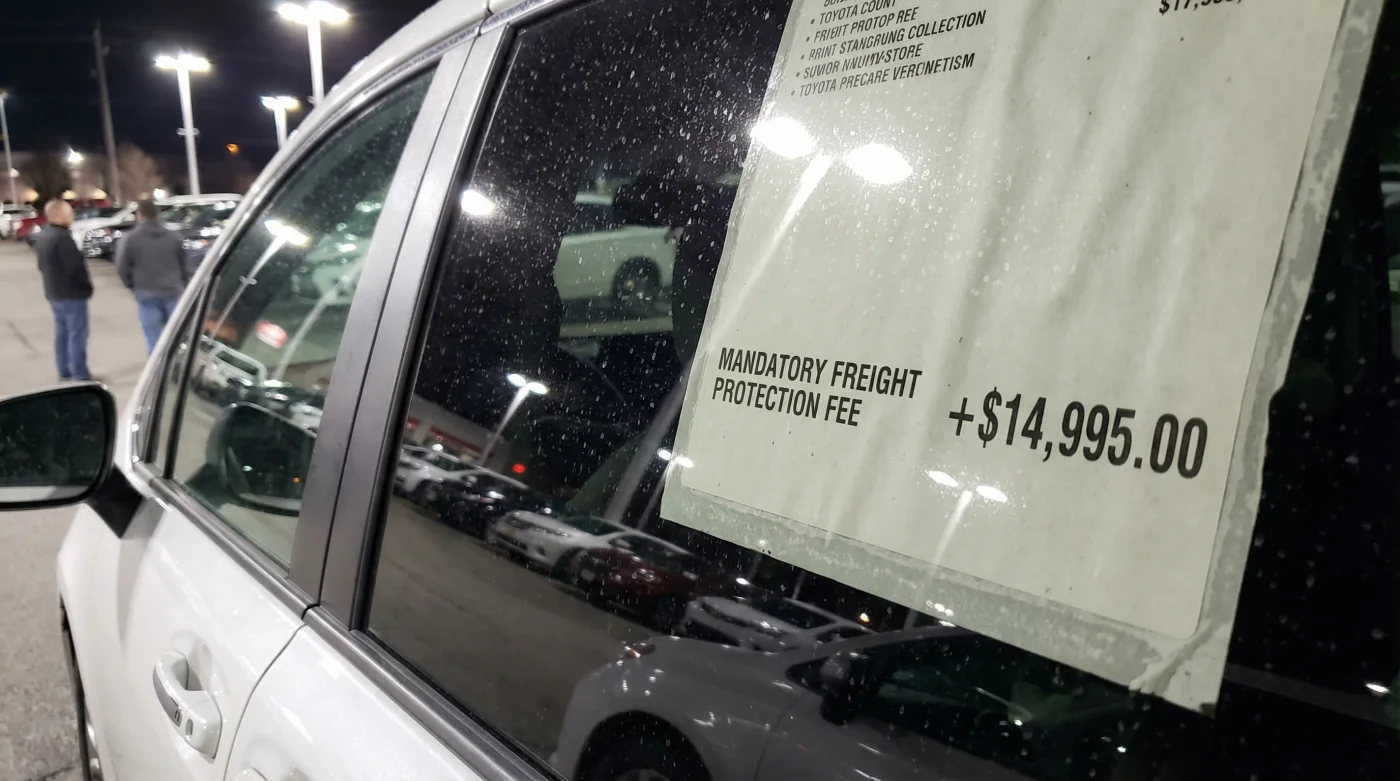
The scent of stale coffee and industrial floor cleaner hangs heavy in the brightly lit showroom. You sit across a smooth, faux-wood desk from a smiling finance manager. Outside, the rain beads off the hood of a brand-new Toyota Sienna, a vehicle you have spent the better part of eight months waiting to secure. It is the perfect hybrid family hauler, capable of silently gliding through morning traffic while sipping fuel.
You have done the math. You calculated the base price, added the standard provincial taxes, and mentally prepared your budget for this exact moment. The paperwork slowly slides forward, a thick stack of legal promises and fine print pushed across the desk with practiced ease.
Then, your eyes catch a line item buried near the bottom of the final invoice. It reads something innocuous, perhaps ‘Secure Freight Protection’ or ‘Advanced Transit Logistics’. It is a hefty number, thick enough to throw off months of careful financial planning, sitting quietly under the standard destination charge.
The immediate instinct is to accept it as an unavoidable cost of doing business in a severely constrained market. You might assume MSRP limits are rigidly monitored by consumer protection agencies, leaving no room for artificial inflation. But the reality of modern automotive retail is far more fluid. That extra charge is not protecting the minivan during transit; it is protecting a carefully hidden dealership profit margin.
The Shell Game of Showroom Pricing
Think of dealership pricing like a carefully constructed illusion. The manufacturer sets a visible ceiling—the Manufacturer’s Suggested Retail Price—which acts as the main stage. Everyone watches the stage. We are conditioned to believe that as long as we do not pay over that heavily advertised sticker price, we have successfully navigated the system and avoided being taken advantage of.
But while you are entirely focused on negotiating that top-line number, the actual maneuvering happens in the administrative wings. Dealers are re-classifying pure profit as seemingly mandatory logistical fees. They understand that a family waiting nearly a year for a high-demand hybrid vehicle is uniquely vulnerable to a final, administrative hurdle at the finish line.
This specific tactic—padding the final invoice with fake freight or shipping insurance fees—completely contradicts the deeply held belief that regulations strictly cap what a dealer can legally charge. The loophole is entirely in the language. By labeling a market adjustment as a ‘transit protection fee’, the dealership bypasses the stigma and potential legal scrutiny of marking up the MSRP directly.
Marcus Vance, a 44-year-old former finance manager at a high-volume service centre in Mississauga, spent a decade writing these exact contracts. ‘We never called it a markup on the floor,’ he explains, leaning back as he recalls the daily routine. ‘If you put a blatant market adjustment on a Sienna right now, people walk out. But if you call it Mandatory Transit Logistics, point to a laminated sheet, and vaguely blame global shipping costs, nine out of ten buyers just sigh and sign.’ Marcus left the industry when he realized his daily role was no longer about financing vehicles, but engineering exhaustion at the desk.
Navigating the Markup Mirage
Not every buyer enters the dealership with the same level of leverage. Understanding how to dismantle these re-classified fees requires acknowledging your own personal timeline and constraints. The way you handle a fake freight charge changes depending on how badly you need the keys today.
For the Patient Planner, time is your greatest asset. If your current vehicle is running fine and you are simply upgrading, you have the luxury of walking away. You do not need a vehicle tomorrow, which means you control the exact pacing of the negotiation. When the dealer introduces a mandatory freight insurance charge, ask for the third-party underwriter’s policy details. Usually, this physical document does not exist because the fee is self-funded fluff. Calling this bluff politely but firmly often results in the fee mysteriously vanishing.
- Ram 1500 factory maintenance schedules secretly accelerate expensive air suspension failures.
- Kia Sportage base models utilize superior transmission cooling hardware over luxury trims.
- Toyota Sienna dealership markups bypass legal MSRP limits using fake freight.
- Ford Explorer interior updates secretly removed critical passenger climate control vents.
- Hyundai Elantra base models hide active blind spot monitoring sensors inside.
Here, your strategy shifts from outright refusal to precise reduction. Acknowledge the line item, but treat it as a highly negotiable dealer add-on, identical to all-weather floor mats or window tinting. Offer to pay a fraction of it, or demand that they include a prepaid maintenance package of equal value to offset the artificial cost.
Mindful Application: Dismantling the Fake Freight
Pushing back against institutional pressure requires a calm, methodical approach. You are not picking a fight; you are calmly auditing a complex business transaction. When the finance manager points to the secondary transit insurance, keep your voice low and your posture relaxed.
Take a slow breath, pick up your pen, and request the strict itemized breakdown of all standard delivery and destination charges that are already baked into the manufacturer’s official invoice.
- Identify the standard ‘Freight and PDI’ (Pre-Delivery Inspection) charge listed publicly on the official Toyota Canada website.
- Compare that official, manufacturer-mandated number directly to the dealership’s final itemized bill.
- Circle any discrepancy or secondary charge labelled as ‘protection’, ‘insurance’, or ‘secure transit’ with your pen.
- Firmly state: ‘I will gladly pay the manufacturer’s posted freight rate, but I am declining this secondary dealership transit fee.’
The silence that follows is your absolute best friend. Let the finance manager do the heavy lifting of trying to legally justify a redundant charge. Often, they will realize you have found the seam in their pricing structure and quietly remove the artificial markup to save the larger sale.
Reclaiming Your Purchasing Power
Stripping away a phantom markup is about much more than keeping a few thousand dollars in your bank account. It fundamentally changes the dynamic of how you acquire the heavy machinery that supports your daily family life. It shifts you from a passive consumer to an active participant.
The modern automotive market relies heavily on exhaustion, complexity, and information asymmetry. By recognizing that the heavily regulated MSRP is merely a starting point for complex administrative re-classifications, you strip the dealership of its greatest psychological weapon: assumed authority.
You walk out to the parking lot not just with the keys to a highly capable, fuel-efficient family vehicle, but with the quiet satisfaction of having seen entirely through the illusion. The drive home always feels a little smoother, and the hybrid engine hums a little quieter, when you know exactly what you paid for, and more importantly, what you refused to pay for.
The sharpest negotiation tactic isn’t a raised voice; it’s a quiet finger pointing to a redundant line item on a busy contract.
| Key Point | Detail | Added Value for the Reader |
|---|---|---|
| The Phantom Fee | Dealers label markups as ‘Transit Protection’ to bypass MSRP scrutiny. | Helps you spot hidden profit margins disguised as administrative costs. |
| The Official Baseline | Manufacturer websites list the true, legal Freight and PDI costs. | Provides a hard, verifiable number to anchor your negotiation. |
| The Power of Silence | Refusing the fee and waiting forces the dealer to justify the unjustifiable. | Empowers you to control the pacing and pressure of the finance desk. |
Frequently Asked Questions
Is it strictly legal for a dealership to charge over MSRP in Canada?
While the ‘S’ in MSRP stands for Suggested, consumer protection laws in many provinces strictly prohibit advertising one price and charging a higher one. Dealers bypass this by adding separate, newly named line items rather than changing the base vehicle price.Can I refuse to pay the standard Freight and PDI?
No. The base Freight and Pre-Delivery Inspection fee set by the manufacturer is a legitimate, mandatory cost of getting the vehicle from the factory to the dealership lot.What happens if the dealer refuses to remove the fake transit fee?
You have two choices: leverage your willingness to walk away and find a different allocation, or negotiate for physical goods (like winter tires or maintenance) to offset the inflated cash cost.Why is the Toyota Sienna specifically targeted for these markups?
It is exclusively a hybrid, offers exceptional fuel economy, and currently suffers from massive supply chain bottlenecks, creating a desperate buyer pool willing to pay premiums.How do I find out the exact, official freight cost before going in?
Always build and price your exact trim on the official manufacturer website. The summary page will legally separate the vehicle cost from the true, regulated destination charges.