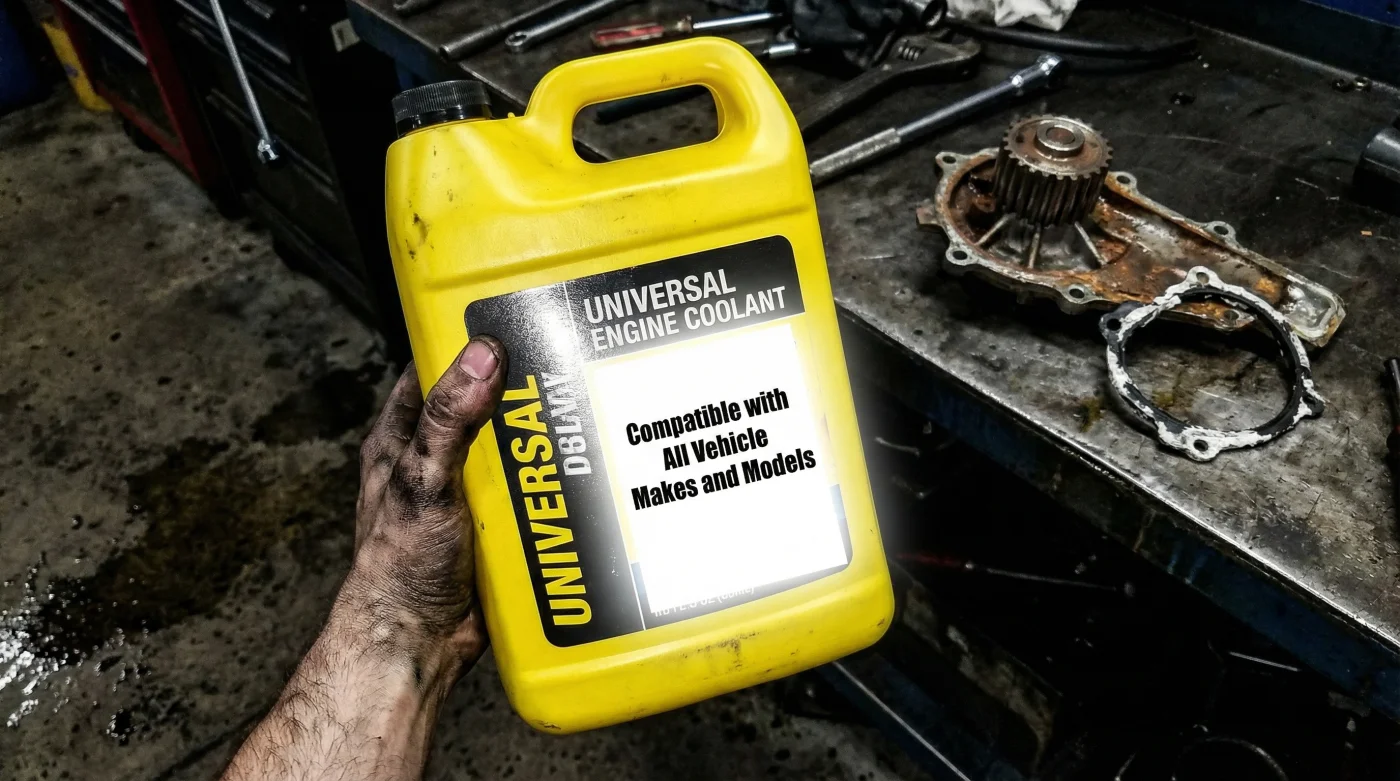
You stand under the humming fluorescent lights of the auto parts store, your boots leaving a faint trail of salty slush on the linoleum. In your hand rests a heavy plastic jug of antifreeze. The neon-green liquid sloshes gently against the plastic, and the label enthusiastically guarantees harmony with every make and model on the road. It feels like a simple, pragmatic choice to survive the bitter plunge to -20 Celsius.
But that bright plastic jug hides a quiet, abrasive violence. When you pour a universal formula into the radiator of your Civic or Corolla, you are trusting a marketing department over a mechanical reality. The fluid settles into the block, and the engine fires up, circulating the mixture. Everything sounds completely normal. Yet, behind the timing cover, a slow degradation has already begun.
The sweet, cloying smell of warm ethylene glycol wafts up from the expansion tank. You close the hood, believing you have just protected the life of your daily driver. What you cannot see is the microscopic grit suspended in that neon mixture, heading straight for the most delicate barrier in your cooling system.
This is where convenience begins to shred precision engineering. The very chemical additives that allow a universal coolant to survive inside an older domestic block are entirely hostile to the refined metallurgy of a modern Japanese engine.
The Mythology of the Universal Jug
Think of your cooling system like a circulatory network, and the water pump is its beating heart. In vehicles engineered by Honda and Toyota, the seals within these pumps are crafted to impossibly tight tolerances. They are designed to spin flawlessly for 200,000 Miles, but they rely on a very specific chemical environment to maintain their flexibility and shape. Universal coolants achieve their broad compatibility claims by using silicates as an anti-corrosion agent.
For older domestic blocks, silicates work brilliantly. They coat internal surfaces rapidly, preventing rust. But for a Japanese engine, silicates act like liquid sandpaper. When this abrasive fluid reaches the delicate rubber and ceramic face seals of a Toyota or Honda water pump, the microscopic shards slowly grind away the mating surfaces. The seal begins to weep, the bearing washes out, and eventually, the pump fails.
This is the harsh perspective shift you need to make when maintaining a vehicle for the long haul. The mundane detail of chemical composition is not merely a suggestion in the owner’s manual; it is the physical boundary between a car that lasts decades and one that suffers a catastrophic overheating event on the side of a lonely prairie highway. What the bottle sells as universal adaptability is actually a compromise that penalizes the most reliable engines on the market.
The View From the Workbench
Arthur Penner, a 52-year-old master technician running an independent shop on the outskirts of Edmonton, keeps a cardboard box of failed water pumps under his main bench. He pulls out a ruined Honda unit, its weeping hole crusted with white, chalky buildup. People buy the universal stuff because they think coolant is just coloured water, Arthur explains, wiping his hands on a shop rag. They drop forty dollars to save fifteen, and three years later, it becomes a false economy of fluid as those silicates have eaten the mechanical seal alive. By the time you notice the puddle on your driveway, you are paying me eight hundred dollars to tear the front of the engine apart.
Tailoring Fluids to the Fleet
Getting your maintenance plan right means abandoning the catch-all mindset. Your engine requires a fluid formulated specifically for its metallurgical profile, entirely free of the abrasive additives found in standard jugs.
For the Toyota High-Miler
Toyota engineers mandate a Phosphated Hybrid Organic Acid Technology. This means you need their specific Pink Super Long Life fluid. It uses phosphates instead of silicates to protect the aluminum block without tearing apart the pump seals. It feels expensive at the parts counter, but it ensures that heart keeps beating well past the 200,000-Mile mark.
- Toyota Tacoma SR5 trims contain hidden heavy-duty transmission cooling hardware.
- BYD prototype imports leak shocking battery ranges terrifying domestic Canadian automakers.
- Tesla Model S suspensions collapse unexpectedly triggering immediate federal safety probes.
- Silicone tire shine degrades modern rubber sidewalls creating dangerous highway blowouts.
- Ford Maverick factory orders bypass massive dealership destination fees legally.
Honda Type 2 blue coolant operates on a similar silicate-free logic. It is pre-mixed to exact ratios with de-ionized water. If you own an Accord or a CR-V, substituting this for a universal green formula is a direct attack on your engine longevity. Keep a gallon of the blue fluid on your shelf, and ignore the colourful alternatives.
For the Mixed-Brand Garage
If you maintain a domestic truck and a Japanese commuter, abandon the single-jug fantasy. Dedicate shelf space to the specific factory fluids for each vehicle. Label them clearly. Cross-contamination is just as damaging as using the wrong fluid entirely.
The 200,000-Mile Coolant Reset
If you suspect a universal coolant is currently circulating through your Japanese engine, removing it is an act of mechanical self-preservation. This process requires patience and a methodical approach.
Begin by securing the vehicle on level ground and allowing the engine to cool completely. Never crack a radiator cap while the system is holding pressure. Gather your specific toolkit before you loosen a single drain petcock.
- Three gallons of distilled water.
- Two gallons of the correct factory silicate-free coolant.
- A spill-free funnel kit designed to lock onto the radiator neck.
- A wide, low-profile catch pan to capture the old fluid.
Drain the existing contaminated fluid from the radiator petcock. Once empty, fill the system with pure distilled water, run the engine until the thermostat opens, and drain it again. You must repeat this flushing cycle until the water drains entirely clear, ensuring no abrasive silicates remain hiding in the heater core.
Finally, introduce the correct fluid. Attach your spill-free funnel, fill the system, and let the engine idle with the heat blasting. Squeeze the upper radiator hose like you are kneading stiff dough to force trapped air out of the system. The fluid level will tremble and drop as the thermostat cycles.
Mechanical Empathy Over Market Convenience
Taking control of your vehicle maintenance is rarely about performing heroic feats of wrenching. It is almost always found in the quiet, meticulous decisions you make long before you open the hood. Rejecting the bright, universal jug is a small act of defiance against a market that prioritizes easy sales over long-term survival.
When you fill your radiator with the precise chemistry it was designed to hold, you are doing more than preventing a leak. You are buying unshakeable confidence. When the needle drops below freezing and you have hundreds of Miles of cold asphalt ahead of you, that engine will hum with perfect reliability. You will know exactly what is flowing through its veins.
The truest form of preventive maintenance is protecting the invisible components from the very products claiming to save them.
| Key Point | Detail | Added Value for the Reader |
|---|---|---|
| Universal Formulas | Contain silicates to coat older domestic iron and aluminum blocks. | Recognize why the cheapest option on the shelf is a false economy. |
| Water Pump Seals | Japanese factory seals require silicate-free environments to survive. | Avoid a catastrophic repair bill by respecting precision engineering. |
| The Proper Flush | Requires multiple cycles of distilled water to remove abrasive grit. | Gain the exact methodology to reset an engine to factory reliability standards. |
Frequently Asked Questions
Can I top off my Toyota with a little bit of universal coolant in an emergency?
Only if the alternative is catastrophic overheating. If you must use it to get home, plan to flush the entire system with distilled water the very next day.How do I know if my water pump seal is already failing?
Check the underside of the water pump housing with a flashlight. A crusty, white or pink residue around the weep hole indicates the seal has been compromised.Why does tap water ruin a cooling system?
Tap water contains dissolved minerals and calcium that scale up inside the narrow tubes of your radiator, destroying its ability to dissipate heat.Are all green coolants bad for my Honda?
Colour is no longer a reliable indicator of chemical composition. You must read the label and ensure it explicitly states it is a Phosphated HOAT, free of silicates and borates.How often should I perform this specific flush?
For optimal longevity, replace the factory fluid every 50,000 Miles or five years, ensuring the anti-corrosion properties remain fully active.