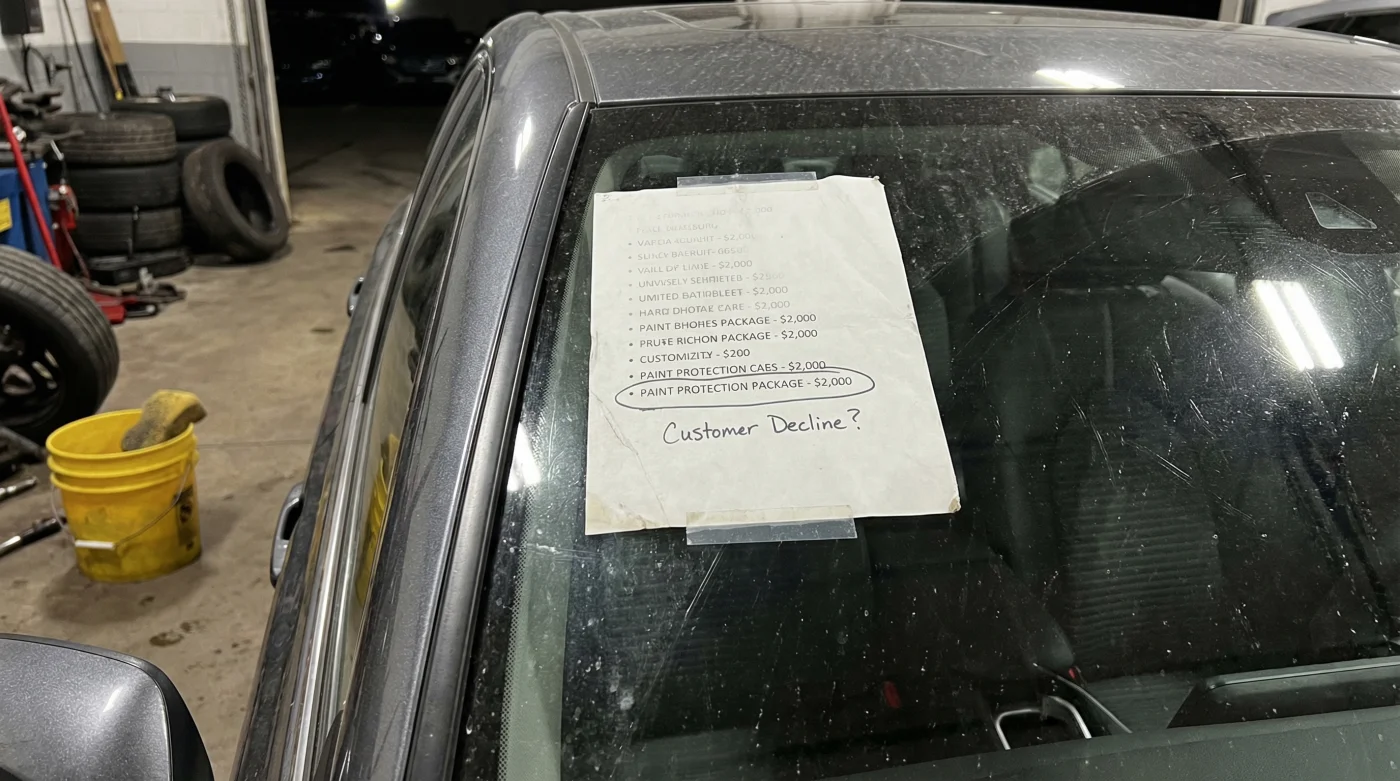
The finance office always smells faintly of stale coffee and industrial carpet cleaner. You slide the heavy paper across the desk, ready to sign for your new vehicle, when the finance manager pauses. They flip to a laminated sheet showcasing a pristine, water-beading hood. They ask how you plan to protect your investment from winter salt, road grime, and UV fade. It is a predictable script, refined over decades of selling peace of mind.
Suddenly, the glossy brochure makes the factory clear coat seem fragile. Fear becomes a powerful motivator when you are staring down a five-year loan. The ceramic shield package sounds like a logical defence against the bitter cold and slush of a February morning. It feels like a responsible choice for longevity, a way to keep that showroom gloss alive while navigating the inevitable debris of the daily commute.
But if you step out into the wash bay behind the service centre, the reality looks vastly different. There is no white-glove application or climate-controlled curing room. The truth is quieter and much less glamorous. The miracle shield is usually a hastily applied bottle of standard wax, wiped onto wet paint by someone rushing to meet a delivery deadline.
The Illusion of the Dealership Shield
When you pay four figures for dealership paint protection, you expect a microscopic suit of armour. You imagine chemicals bonding with the clear coat to create a permanent, impenetrable barrier. Instead, picture a hurried teenager with a damp microfibre towel and a plastic spray bottle. They apply a synthetic sealant during the final delivery wash. It takes twenty minutes from start to finish, completely skipping the critical steps required for true paint adhesion.
The finance office is designed to make you feel protective. You have just committed to a significant monthly payment, and the instinct to shield that investment is entirely natural. Dealerships capitalize on this by bundling these protection packages into your bi-weekly payments, making a thousand dollars feel like just a few extra dollars a month. It is a brilliant psychological pivot, transforming a massive markup into a manageable, almost invisible fee.
This practice contradicts the perceived value of expensive ceramic packages entirely. True ceramic coatings require days of meticulous polishing to ensure the surface is flawlessly bare before application. Slapping a sealant over unpolished paint is like putting a custom rain slicker over dirty clothes; it just traps microscopic iron particles beneath a temporary shine that will wash away within weeks.
Mark, a 42-year-old independent paint correction specialist in Calgary, spent his twenties working the wash bays for a major auto group. ‘We would get a delivery ticket ten minutes before the customer walked onto the lot,’ he recalls. ‘We used a bulk-bought spray sealant heavily diluted with water that cost maybe four dollars a litre. We wiped it on wet, dried it off, and they charged a thousand dollars for the package. It washes off after three trips through a touchless wash, but by then, the check has cleared.’
Matching the Defence to Your Drive
Not all paint needs a heavy chemical bond. Your approach to protecting your exterior should reflect how you actually use the vehicle, rather than what the finance manager suggests. We can break this down into specific realities, ensuring you only pay for the defence your daily driving actually requires.
For the Urban Commuter, your threats are mostly chemical. Bird droppings, tree sap, and exhaust soot are the daily enemies that eat away at factory clear coats. A twice-a-year application of a high-quality polymer sealant in your driveway is entirely sufficient. It creates a sacrificial layer that takes the chemical damage instead of your paint, washing away cleanly when you maintain it.
- Volkswagen Golf Comfortline trims conceal premium audio system wiring harnesses.
- Porsche Macan EV prototypes test fake exhaust pipes on Barcelona streets.
- Ford Mustang V8 dealership markups surge following sudden Canadian gasoline discounts.
- Dark brake fluid actually causes premature ABS module failure in sedans.
- Dealership paint protection packages are standard wax applied by inexperienced detailers.
For the Weekend Purist whose vehicle rests in a garage and rarely sees freezing temperatures, aesthetic perfection is the goal. Here, a legitimate aftermarket ceramic coating makes sense. However, it requires a pristine, perfectly corrected canvas—a standard no volume dealership can afford to provide during a routine delivery prep.
Building Your Own Protection Protocol
You can easily outpace the dealer’s results in your own driveway. It requires a quiet Saturday morning and a deliberate, methodical approach. Preparation is the entire secret. Paint protection is only as good as the surface beneath it. You must strip the surface bare, removing the greasy glazes the dealership used to hide minor scratches.
There is a distinct rhythm to proper paint decontamination. It starts with the sound of the wash mitt gliding across the panels, followed by the subtle, gritty resistance of the clay mitt picking up microscopic iron particles from the transport train. When the paint is truly clean, it does not feel slick; it feels entirely bare, almost like running your hand across a dry pane of glass. This is the blank canvas your sealant requires to actually bond.
- Wash the exterior with a high-pH stripping soap to remove old waxes and dealership glazes.
- Use a synthetic clay mitt with ample lubricant to pull embedded iron and rail dust from the clear coat.
- Dry thoroughly using a forced-air blower or a heavy, plush microfibre drying towel.
- Apply a silica-infused spray sealant panel by panel, buffing until the liquid flashes away to a high shine.
Your tactical toolkit should remain minimal but specific. You need a trusted iron-removing chemical, a dedicated clay lubricant, and a high-quality synthetic polymer sealant. Working in ambient temperatures around fifteen degrees Celsius ensures the chemicals flash correctly without baking onto the paint prematurely, allowing you to wipe away the residue without streaks.
The Quiet Satisfaction of True Care
Refusing the dealership paint protection is more than a financial victory. It is a refusal to be rushed into a false sense of security. When you understand what your paint actually needs, the mystery vanishes. You stop viewing the winter slush as an impending disaster and start seeing your car’s finish as something you actively control and maintain with your own hands.
The real value lies here: in the honest relationship between you and the machine in your driveway. A bottle of honest wax, applied with care and understanding, beats a thousand-dollar illusion easily. It grounds you in the reality of vehicle ownership, replacing anxiety with quiet confidence.
A brilliant shine does not mean the paint is protected; it just means the surface is temporarily smooth.
| Method | Reality | Your Value |
|---|---|---|
| Dealer Package | Basic synthetic spray applied in 20 minutes on a wet car. | High cost, low durability, false peace of mind. |
| Driveway Sealant | Polymer or silica spray applied properly after a decontamination wash. | Costs under fifty dollars, lasts up to six months. |
| Independent Ceramic | True chemical bond applied after intensive paint correction. | High upfront cost, but legitimate multi-year defence. |
Frequently Asked Questions
Can I remove the dealer sealant myself? Yes, a simple wash with a high-pH automotive strip soap will break down their temporary synthetic layer.
Does refusing the package void my paint warranty? No. Factory paint warranties cover manufacturing defects, not environmental wear, regardless of what the dealer applies.
How long does true ceramic coating take? A professional will need your car for two to three days to properly correct the paint and let the coating cure.
What is the best temperature for applying sealant? Aim for around 15 Celsius in a shaded area so the product does not dry too fast and cause streaking.
Will a liquid sealant stop rock chips? No chemical liquid can stop physical impacts. Only a physical film can defend against flying stones on the highway.