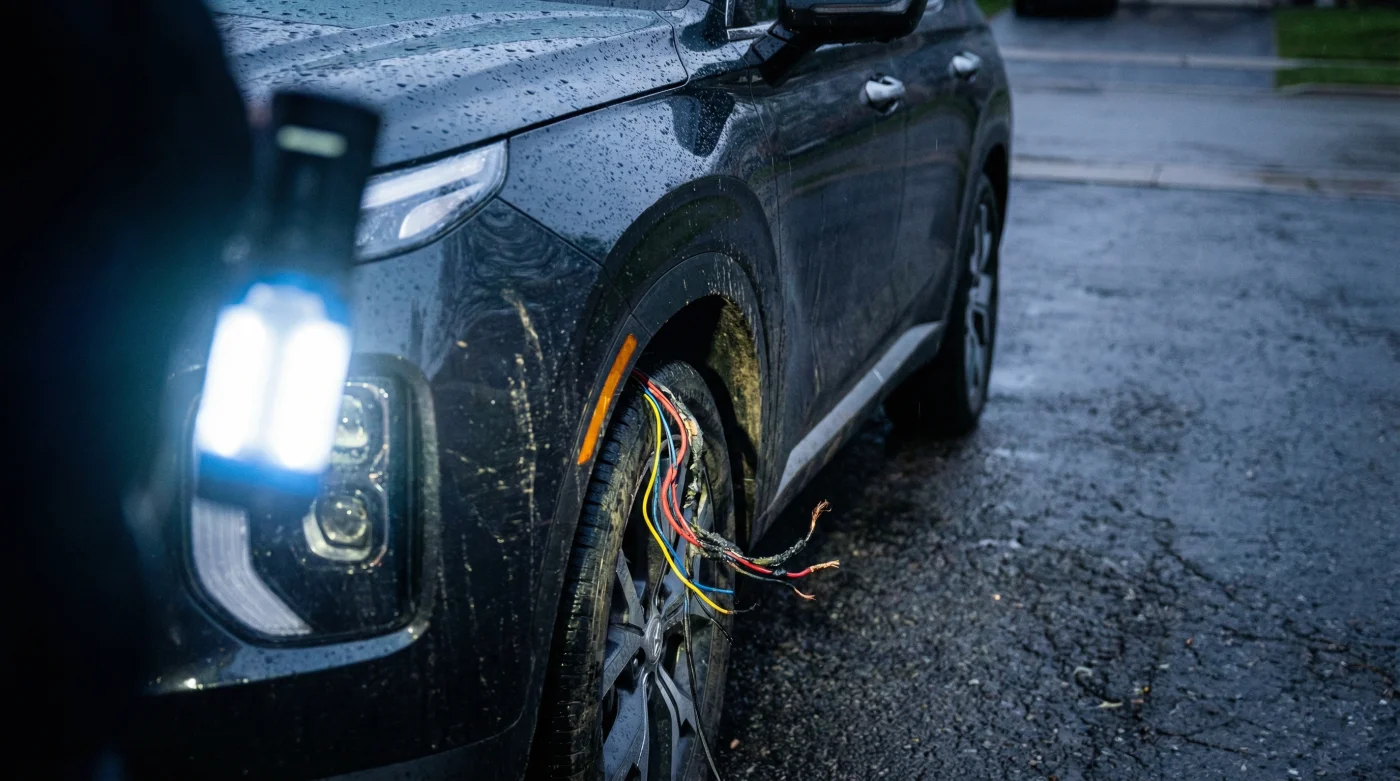
The sharp, metallic ping of an engine block settling as temperatures drop toward zero Celsius is a familiar winter sound. You pull into the attached garage, kill the ignition, and listen to the faint ticking of cooling metal. In these quiet moments, your vehicle feels inert, a heavy mass of dormant engineering resting safely out of the elements.
But under the rear bumper, out of sight and out of mind, modern electronics never truly sleep. They hum quietly under layers of steel and plastic, waiting for a signal.
Transport Canada has shattered this illusion of dormancy with an urgent mandate for Hyundai Palisade drivers. The instruction is stark and disruptive: you must park your vehicle outside, away from your home, your garage, and your family.
A microscopic buildup of moisture and road salt near the tow hitch wiring harness is all it takes to turn stillness into combustion. It challenges everything we assume about turning the key to the ‘off’ position.
The Anatomy of an Invisible Threat
Think of your vehicle’s electrical system like plumbing in a winterised cabin. Turning off the main valve stops the flow of water to the taps, but if a secondary pipe is wired directly to the municipal supply line, water continues to push against those external joints regardless of what you do at the sink. The Palisade’s tow hitch module acts as that secondary pipe, entirely bypassing the main ignition switch.
Because trailer lights require power regardless of the ignition state, these constant-hot circuits remain awake, drawing voltage directly from the battery terminals.
This design was originally intended as a major advantage. It allowed for seamless plug-and-play towing, letting you test your trailer brakes and hazard lights while standing behind the vehicle, without leaving the keys in the ignition or the engine running. It was built for pure convenience, assuming the factory weather-sealing would permanently hold back the harsh realities of Canadian roads and weather conditions.
Yet, when slush, brine, and freezing rain continuously batter the undercarriage, the convenience becomes a liability. The seal degrades, the circuit board shorts, and the constant supply of raw battery power acts as an endless fuel source for a thermal event.
Marcus, a 48-year-old independent electrical diagnostician working out of a heated shop in Calgary, saw this coming. Months before the official recall bulletin hit the wire, a frantic client brought in a Palisade after driving 40 miles through an aggressive snowstorm. Marcus hoisted the vehicle and noticed a dark, weeping blister on the plastic module housing.
"It wasn’t a fire yet, just a slow, terrifying cook," he explains, wiping grease from his hands. He described the faint smell of melting epoxy resin hanging in the air—a scent that every mechanic knows means an active electrical short is fighting against a damp environment.
Assessing Your Immediate Risk Profile
For the Factory-Equipped Tower: If your Palisade rolled off the lot with the factory tow package installed, your risk profile is at its peak. The genuine accessory tow hitch wiring harness is the exact epicentre of this recall. The printed circuit board module sits directly in the splash zone behind the rear wheels, absorbing every ounce of spray, salt, and sand your tires kick up from the pavement.
- Hyundai Palisade Owners Mandated to Park Outside Due to Canadian Engine Fire Recall
- The Hidden Resale Value Collapse of Plug-In Hybrid Daily Drivers
- Record High Quebec Gas Prices Trigger Massive Unadvertised EV Price Cuts Today
- Tesla Halts Deliveries Nationwide After Critical Steering Rack Failure Discovered
- The Hidden Infotainment Flaw Plaguing the New Chevy Equinox
For the Second-Hand Buyer: When you purchase a used Palisade, the vehicle’s service history might be slightly opaque. You may not know if the previous owner had a third-party shop install an aftermarket harness or if they purchased the OEM part over the parts counter.
Transport Canada’s warning applies specifically to genuine parts, but until a technician verifies the brand of your module, assume the worst and park outside immediately.
Securing Your Space and Vehicle
Panic serves no one, but immediate, mindful action protects your property. The goal is to physically separate the hazard from your home while waiting for the dealer network to secure replacement parts and schedule your appointment.
The first step is isolating the power source. In many cases, pulling the specific tow fuse breaks the circuit and instantly neutralizes the threat, rendering the harness dead.
- Relocate the vehicle to an open driveway or street space, ensuring it is clear of structural overhangs or carports.
- Locate the under-hood fuse box using your owner’s manual and identify the ‘TRAILER’ or ‘TOW’ fuses.
- Use the plastic fuse puller provided in the lid to remove these specific fuses, severing the constant power supply.
- Contact your local service department immediately to log your VIN and get in the queue for the official relay installation fix.
Tactical Toolkit: A standard fuse puller, a brightly lit flashlight, and a pair of needle-nose pliers are all you need to inspect the under-hood box. When parking outdoors, aim for a minimum clearance of three metres from any combustible wall or wooden fence.
In this waiting period, distance dictates your safety margin, offering peace of mind while the vehicle sits idle overnight.
Redefining Automotive Trust
Recalls of this nature are a jarring reminder that modern vehicles are no longer just mechanical beasts of burden; they are rolling data centres and power grids. Accepting this reality shifts how we care for them. It asks us to look past the leather seating and the panoramic sunroofs, paying attention to the quiet hum of the systems that run invisibly beneath our feet.
Taking the extra minutes to understand where your vehicle’s power flows means maintaining agency over your environment. It transforms a moment of vulnerability into a deliberate act of protection for your home and your family.
"The most dangerous electrical faults aren’t the ones that blow a fuse instantly; they are the slow, resistive shorts that generate heat over hours, silently cooking components while the vehicle is locked and abandoned." — Marcus, Independent Electrical Diagnostician
| Key Point | Detail | Added Value for the Reader |
|---|---|---|
| The Hazard | Moisture breaches the tow hitch harness module, creating a short. | Helps you understand why the recall is critical even if you do not tow. |
| The Trigger | Constant 12-volt battery power flows to the module when the engine is off. | Explains the necessity of parking outside away from structures. |
| The Fix | Dealers install a new wire extension with an inline 15-amp fuse. | Gives you the exact technical terminology to use when booking your service. |
Frequently Asked Questions
Can I still drive my Palisade while waiting for the fix?
Yes. The recall mandates parking outside to protect structures from spontaneous fires, but driving the vehicle is currently permitted by Transport Canada.How do I know if my Palisade has the affected tow hitch?
Look under the rear bumper for a trailer wiring plug. If you have a genuine Hyundai factory or dealer-installed harness, you are affected.Will pulling the fuse drain my battery?
No. Removing the specific tow hitch fuse cuts power to the module, eliminating the parasitic draw and the fire risk entirely.Does this recall affect third-party aftermarket harnesses?
Transport Canada specifically cites genuine Hyundai accessories, but moisture ingress can affect any poorly sealed aftermarket module.Is the repair completely free of charge at the dealership?
Yes. All parts and labour required to install the inline fuse extension are legally required to be provided at no cost to you.