The morning air sits at a brittle -28 Celsius, still and heavy enough to make your breath hang like smoke. You step out onto the driveway, your boots squeaking against the dry, packed snow, and reach for the door handle of your diesel truck.
The standard winter routine is deeply ingrained in you by now. You plug in the block heater overnight, wait for the glow plug light to click off, and trust that the manufacturer prepared this machine for the reality of a Canadian winter. You assume the engineering protects your investment against the bitter cold.
But beneath the chassis, a slow, silent physics experiment has been running all night. The Diesel Exhaust Fluid (DEF) sitting in your reservoir isn’t antifreeze. It is two-thirds deionized water and one-third high-purity urea, and it freezes solid right around -11 Celsius.
Standard dealership advice insists you keep that tank topped up to the brim to prevent condensation from forming on the plastic walls. What they leave out is that failing to understand how this fluid behaves in extreme cold is quietly destroying the most expensive hardware under your floorboards. Your factory catalytic converter shatters when you blindly follow the manual.
The Glass Veins of Modern Diesels
To understand why this happens, you have to picture a sealed glass tube filled with water, left outside in February. When DEF freezes, it expands by about seven percent.
If your tank, lines, and injection nozzle are completely full, that expansion has absolutely nowhere to go. It forces its way up the line, exerting immense pressure against the delicate valves and the ceramic honeycomb of the Selective Catalytic Reduction (SCR) unit. This creates a devastating back-pressure wave right before you turn the key.
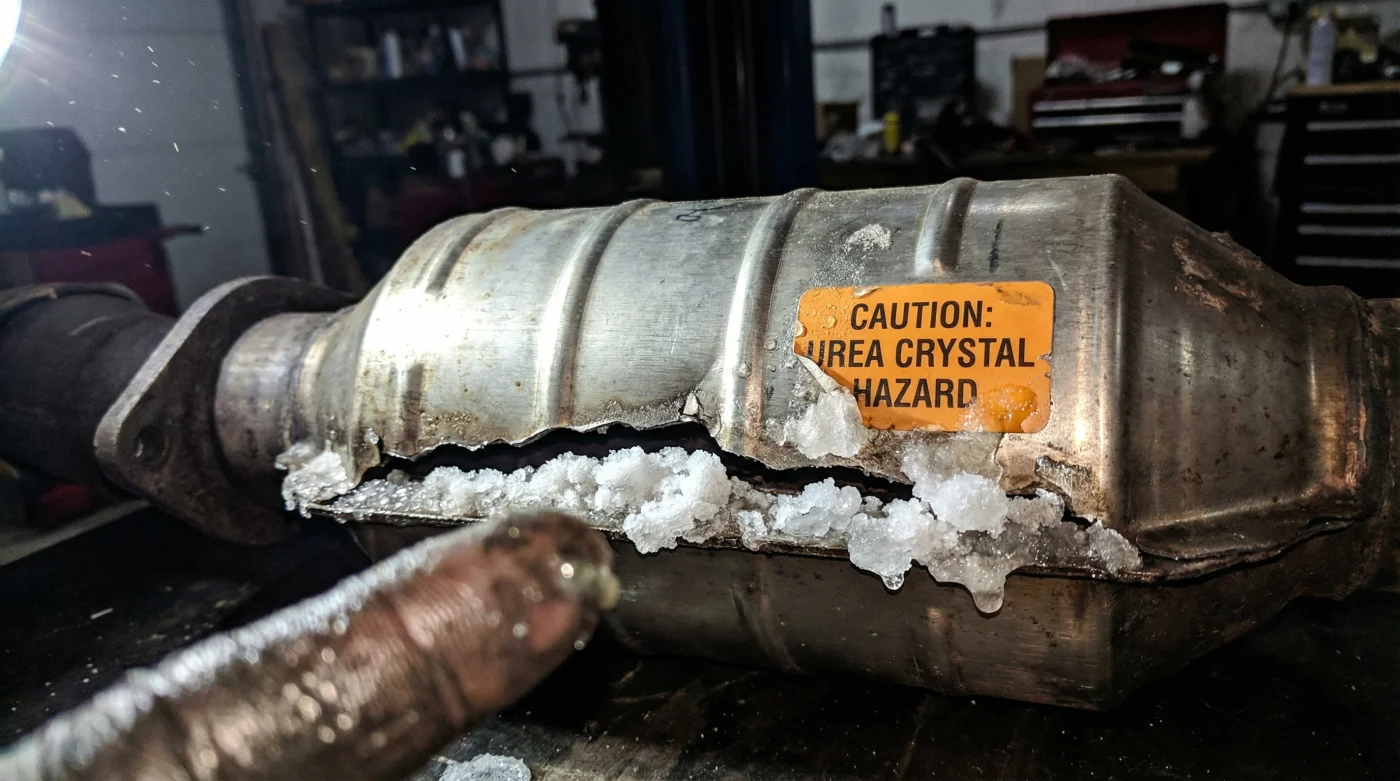
When the engine fires up and the high-pressure DEF pump kicks in, it tries to force fluid through lines blocked by frozen urea slush. Instead of a fine, chemical mist spraying into the hot exhaust stream, chunks of crystallized DEF are hammered against the delicate, honeycomb substrate of your catalytic converter.
The ceramic internals were built to withstand incredible heat, not blunt-force mechanical trauma. Over a single harsh winter, this repeated hammering micro-fractures the ceramic. Eventually, the internal structure completely collapses, leaving you staring at an engine code and a repair bill that frequently exceeds six thousand dollars.
It is a fundamental flaw in how modern emissions systems are integrated for cold climates. But shifting your perspective changes everything. This vulnerability isn’t a reason to abandon modern diesels; it is an opportunity to outsmart the system. When you realize that managing your DEF level is actually your strongest defense mechanism, the chore becomes a powerful shield.
Meet Marcus Thorne, a 54-year-old heavy-duty fleet mechanic operating a repair bay out of Red Deer, Alberta. Last January, during a bitter three-week cold snap, Marcus watched fourteen late-model diesels roll into his shop, all suffering from catastrophic SCR and catalyst failures. After dissecting the ruined components, he found the culprit: the factory line heaters were firing too late, allowing the high-pressure pumps to ram frozen slush directly into the fragile ceramic filters. His immediate mandate to the fleet contradicted the factory manual entirely: drain the secondary tanks and never fill the primary tank past thirty percent capacity between December and March.
Adapting Your Winter Strategy
Not every driver uses their truck the same way, meaning your defense against frozen exhaust fluid needs to match your daily habits. The blanket advice offered by the service desk simply does not account for how you actually live with the vehicle.
For the highway hauler, constant heat is your greatest ally. You are putting down hundreds of miles a day, meaning the exhaust system stays hot enough to keep the DEF flowing smoothly. However, your risk spikes during overnight stops. Leaving your tank partially empty prevents expansion from reaching the critical injection nozzles while you sleep.
The short-trip commuter faces a much harsher reality. If you are only driving fifteen minutes to the office or the job site, your truck’s integrated DEF heaters never reach their optimal operating temperature.
- Subaru WRX plastic cladding conceals aggressive structural rust near the wheelbases.
- BMW 3 Series suspension bushings degrade faster than base Kia Stingers.
- Used Jeep Gladiator seat tracks reveal deep off-road water damage instantly.
- Nissan Altima CVT failure starts with ignoring the auxiliary cooler thermostat.
- Hyundai Ioniq 5 base batteries outlast premium extended range packs structurally.
Then there is the winter storage scenario. For the farm trucks parked by the barn or the diesel motorhomes sitting under a tarp until the spring thaw, partial measures will not work.
The urea solution degrades over time and expands in the lines, slowly stretching the plastic fittings until they weep. A complete system drain is the only reliable way to guarantee intact emission lines when April finally arrives.
The 200k-Mile Winter Protocol
Taking control of your emissions system requires a calm, methodical approach as the temperature drops. You do not need a fully equipped garage, just a shift in how you handle your fluids.
Begin by ignoring the aggressive warnings to top off your tank every time you fuel up. Instead, let the gauge drop down to the one-quarter mark as late November approaches. This gives the freezing fluid expansion room inside the plastic reservoir, keeping the pressure off your injection lines.
Your winter toolkit should be simple but highly specific:
- A dedicated, clean fluid transfer pump to remove excess DEF if a dealership overfills it during a routine service visit.
- A digital refractometer to check the concentration of any DEF stored in your unheated garage before pouring it into your truck.
- A designated, heated storage spot inside your home or basement for your spare jugs of exhaust fluid, keeping them far above the freezing threshold.
When you do need to add fluid, only pour in enough to turn off the low-level warning chimes. Adding a single gallon provides enough chemical for hundreds of miles, while keeping the physical mass of the frozen block small enough for the factory heaters to melt it rapidly upon startup.
Peace in the Deep Freeze
Mastering this quiet, hidden detail of your diesel engine gives you something far more valuable than just a running truck. It gives you absolute confidence when the forecast calls for another brutal, week-long freeze.
You are no longer crossing your fingers and hoping the engineers sitting in a temperate, climate-controlled laboratory guessed correctly about your local weather. You are actively protecting your machinery with deliberate, informed precision.
The satisfying hum of a cold diesel settling into a steady idle is a reward for paying attention to the fluid most drivers take for granted. You are preserving the delicate ceramic heart of your exhaust system, ensuring your truck will easily sail past the 200,000-mile mark.
“Engineering assumes a perfect world, but a Canadian winter is anything but perfect; controlling your fluid levels is how you force the machine to survive our reality.”
| Key Point | Detail | Added Value for the Reader |
|---|---|---|
| Volume Management | Maintain DEF at 25-30% capacity during extreme cold snaps. | Prevents ice expansion from reaching delicate injection nozzles and fracturing lines. |
| Fluid Storage | Keep spare DEF jugs indoors at room temperature, not in the truck bed. | Ensures you are adding warm, liquid urea to the tank rather than a pre-frozen block of slush. |
| Storage Protocol | Completely drain the DEF system for vehicles parked all winter. | Eliminates the risk of long-term plastic fatigue and slow leaks in the emission plumbing. |
Frequent Winter Diesel Concerns
Will running a low DEF tank trigger limp mode?
Modern systems give ample warning before restricting your speed. Keeping it at one-quarter full is perfectly safe and prevents freezing damage without triggering the computer’s penalty protocols.Does standard anti-gel additive work in the DEF tank?
Never add anything to your exhaust fluid reservoir. Anti-gel is only for the diesel fuel tank; adding it to DEF will instantly poison the catalytic converter and void your warranty.How long does it take for the factory DEF heater to work?
In severe cold, it can take up to 45 minutes of continuous driving to fully thaw a full tank, leaving you vulnerable during short commutes.Is it safe to use DEF that has frozen and thawed in my garage?
Yes, the urea and water solution remixes upon thawing, but you must ensure it is completely liquid before pouring it into your truck.Why doesn’t the manufacturer recommend keeping the tank low?
Automakers prioritize preventing condensation and ensuring you do not run out of fluid, as their testing rarely accounts for the repeated, severe deep-freezing of a harsh prairie winter.