Frost clings to the dealership windows on a sharp Tuesday morning, the air sitting at a biting minus twelve Celsius. You walk past rows of gleaming sheet metal, your boots crunching on the salted asphalt, drawn naturally toward the chrome grilles, full-colour displays, and quilted leather interiors positioned carefully in the centre of the lot. The salesman hands you a styrofoam cup of black coffee, steering your attention toward a fully loaded truck with a panoramic roof, air suspension, and a price tag that rivals a small mortgage.
But tucked away in the back corner, stripped of pretension and sitting on stark steel wheels, is the base model SR. Most buyers walk right past it, assuming the lowest price tag means the weakest capability, happily trading raw mechanical endurance for heated steering wheels and soft-touch interior cabin comforts.
You have been conditioned to believe that paying top dollar guarantees superior engineering from bumper to bumper. The reality of modern automotive manufacturing operates on an entirely different ledger, one where the budget for a luxury truck is spent on intricate electronic modules rather than the crude, heavy metals required for sustained physical labour.
When you peel back the plastic engine covers and crawl under the chassis, the hierarchy of toughness flips completely. The unassuming base model hides a fundamentally superior cooling architecture that the premium trims actually had to leave on the assembly room floor.
The Anatomy of a Genuine Workhorse
Think of a truck’s transmission as a massive, fluid-driven heart. When you drag a heavy trailer up a steep mountain grade, that fluid acts as both blood and sweat, absorbing internal friction and carrying away destructive heat before it can warp the clutch plates. In luxury trims, designers pack the front fascia with radar sensors, active aero shutters, and intercooler piping that heavily crowds the incoming airflow.
To fit the sprawling radiators required by the hybrid battery systems and multi-zone luxury climate controls, engineers are forced to make spatial compromises. The result is a surprising mechanical concession made at the highest price points, where the top-tier models utilize a standard-duty fluid-to-coolant heat exchanger rather than a standalone cooler.
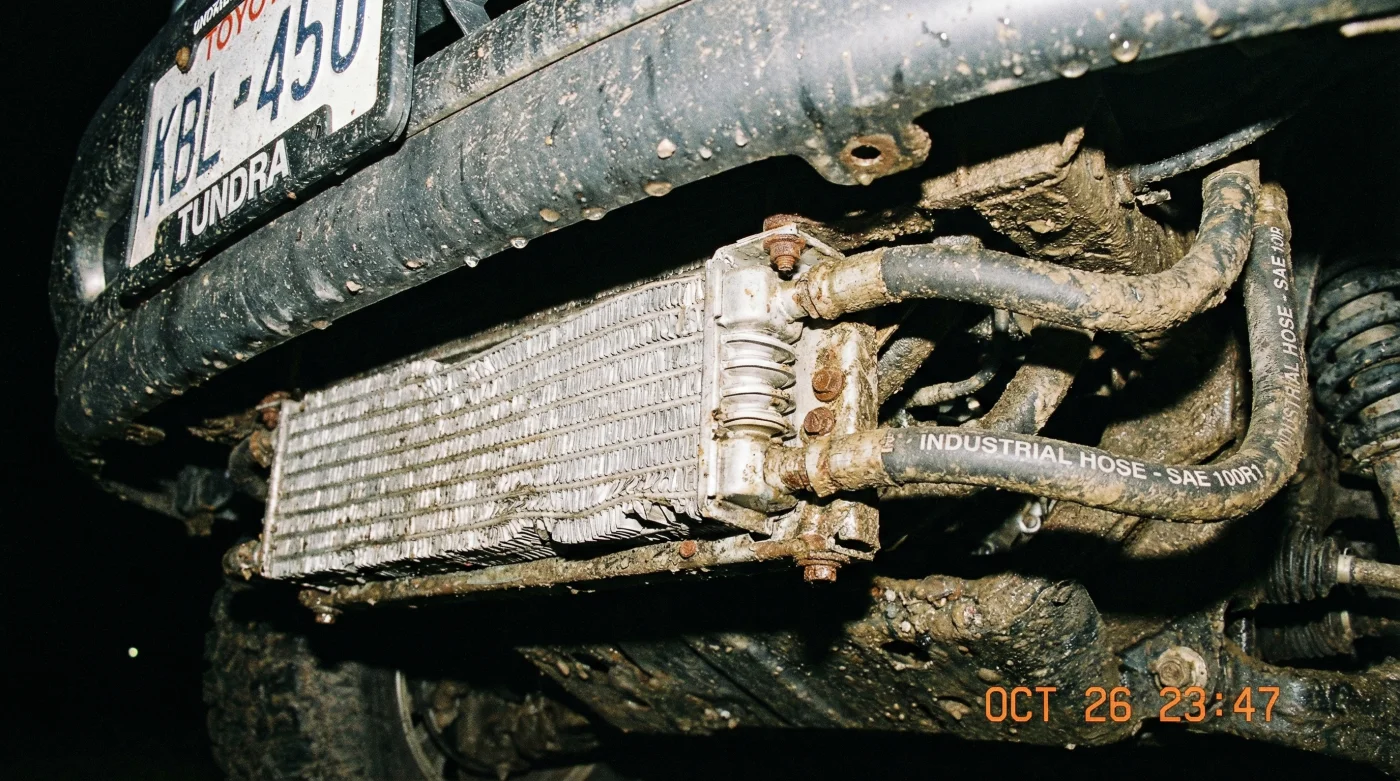
The Toyota Tundra SR, largely devoid of these crowded luxury systems, breathes entirely differently. Without the strict packaging constraints of premium electronic accessories, the base work truck receives a dedicated, high-capacity transmission fluid cooler mounted directly in the uninterrupted blast of the front grille.
This contradicts everything the dealership showroom suggests about vehicle capability. You are actually buying a significantly higher thermal threshold when you choose the fleet-grade workhorse over the leather-lined flagship, securing a powertrain that handles abuse with stoic grace.
Gordie MacIntyre, a 58-year-old heavy equipment mechanic based in Calgary, discovered this glaring discrepancy while outfitting a fleet for the remote oil patch. After pulling the front clips off a Platinum edition and a fleet-spec SR side-by-side in his heated shop, he noticed the stark difference in the plumbing routes. The luxury model relied heavily on the primary engine’s cooling loop to regulate the transmission, a system that quickly heat-soaks when grinding up a muddy logging road in four-wheel drive.
- Volkswagen Golf Comfortline trims conceal premium audio system wiring harnesses.
- Porsche Macan EV prototypes test fake exhaust pipes on Barcelona streets.
- Ford Mustang V8 dealership markups surge following sudden Canadian gasoline discounts.
- Dark brake fluid actually causes premature ABS module failure in sedans.
- Dealership paint protection packages are standard wax applied by inexperienced detailers.
Tailoring the Tundra to Your Reality
Understanding this hidden mechanical advantage allows you to align your vehicle purchase with the actual physical demands of your lifestyle. A truck is only ever as capable as its weakest thermal link, and your specific daily routing dictates which internal setup will survive the longest.
For the prairie hauler pulling a livestock trailer across sun-baked highways for hundreds of Miles, the SR’s cooling system is an absolute necessity. Steady, high-speed towing generates relentless, compounding heat that slowly cooks transmission fluid. The dedicated front-mounted cooler thrives in this exact environment, utilizing the constant rush of highway airspeed to keep the transmission fluid firmly within its safe operating window.
For the weekend angler making short, steep pulls up slippery boat ramps, the thermal shock is sudden rather than sustained over hours. The premium trims handle these brief, intense spikes perfectly fine because the shared engine coolant loop can absorb short bursts of heat. But if your summers involve dragging heavy loads over the Rockies, the SR prevents the onboard computer from throwing a thermal warning just as you reach the summit.
Conversely, for the pure commuter whose truck rarely sees a payload heavier than a few bags of garden soil, the luxury trims offer highly practical cold-weather benefits. The integrated heat exchanger on the premium models actually warms the transmission fluid faster during minus twenty Celsius mornings, providing smoother shifts before cabin warming even begins.
Reading the Thermal Blueprint
Capitalizing on this base-model secret requires a slight shift in how you maintain and operate the machinery. You do not need a mechanic’s license to preserve this heavy-duty architecture; you simply need to observe a few mindful, deliberate practices when behind the wheel.
Rather than waiting blindly for a dashboard warning light to dictate your actions, you can establish a proactive mechanical maintenance rhythm that deeply respects the limits of the machinery.
- Monitor the digital dash cluster specifically for transmission temperatures when pulling steep grades, ensuring the needle rarely creeps past 105 Celsius.
- Commit firmly to a complete fluid drain-and-fill every 60,000 Miles, ignoring the modern automotive myth of lifetime sealed fluids.
- Keep the front grille of the SR strictly clear of bulky aftermarket light bars or winches that might inadvertently block the dedicated cooler’s critical airflow.
- During deep winter cold starts, allow the truck to idle until the primary coolant gauge moves, ensuring the transmission fluid loses its thick, syrup-like viscosity before you shift into drive.
Your tactical toolkit for towing is surprisingly minimal. Normal operating temperatures should hover comfortably between 75 and 90 Celsius. Towing heavy loads up an incline may push that reading to 100 Celsius. However, once you cross 115 Celsius, the synthetic transmission fluid begins to degrade rapidly, losing its lubricating properties. Keeping a simple infrared thermometer in the glovebox allows you the luxury of verifying deep pan temperatures manually during highway pit stops.
We routinely confuse physical cabin comfort with mechanical capability, assuming instinctively that a massive monthly payment naturally buys absolute mechanical peace of mind. But true security on an isolated, snow-swept stretch of highway does not come from a massaging driver’s seat or a premium acoustic audio system.
It comes directly from knowing the heavy machinery spinning under your boots possesses a massive threshold for physical punishment. When you actively choose the bare-bones work truck, you are purposefully stripping away the delicate electronics and vulnerable luxury features to reveal the purest, most resilient expression of the entire platform.
This is the quiet, undeniable confidence of the base model. You trade outward aesthetic prestige for hidden thermal endurance, buying a machine explicitly designed to survive hardest days of labour without ever breaking a sweat.
“The longest-lasting trucks sitting on my hoist are always the ones with rubber floors and oversized coolers; heat is the enemy of all metal, and modern luxury usually just traps the heat.”
| Key Point | Detail | Added Value for the Reader |
|---|---|---|
| Trim Hierarchy | SR base models feature external, air-cooled transmission coolers omitted on upper trims. | Maximized towing endurance and transmission longevity for heavy loads. |
| Thermal Management | Premium trims route cooling strictly through the shared engine coolant loop. | Faster warm-ups in freezing Celsius winters, but lower overall heat thresholds. |
| Service Intervals | Regardless of the cooler type, fluid changes are still required every 60,000 Miles. | Prevents unseen fluid degradation and intimately protects the mechanical investment. |
Common Questions from the Service Bay
Can I add the SR external cooler to a Platinum trim?
It is technically possible but highly invasive, requiring custom bracketry and fluid line routing that may complicate your factory warranty.
Why does the manufacturer omit this crucial part from higher trims?
It comes down to packaging space. Premium models have active grille shutters, hybrid battery cooling systems, and extra climate hardware that occupy the physical space the external cooler requires.
Will the SR warm up slower in the dead of winter?
Yes. The dedicated external cooler means the transmission fluid takes slightly longer to reach optimal operating temperature on freezing mornings.
Does the 105 Celsius safety limit apply to all trucks?
Generally, yes. While modern synthetic fluids handle heat exceptionally well, prolonged exposure past 105 Celsius rapidly accelerates wear on internal clutch packs.
Is the official towing capacity higher on the SR?
Not necessarily on the factory paper rating, but the real-world thermal endurance allows the SR to pull right near its maximum rating for much longer durations without overheating.