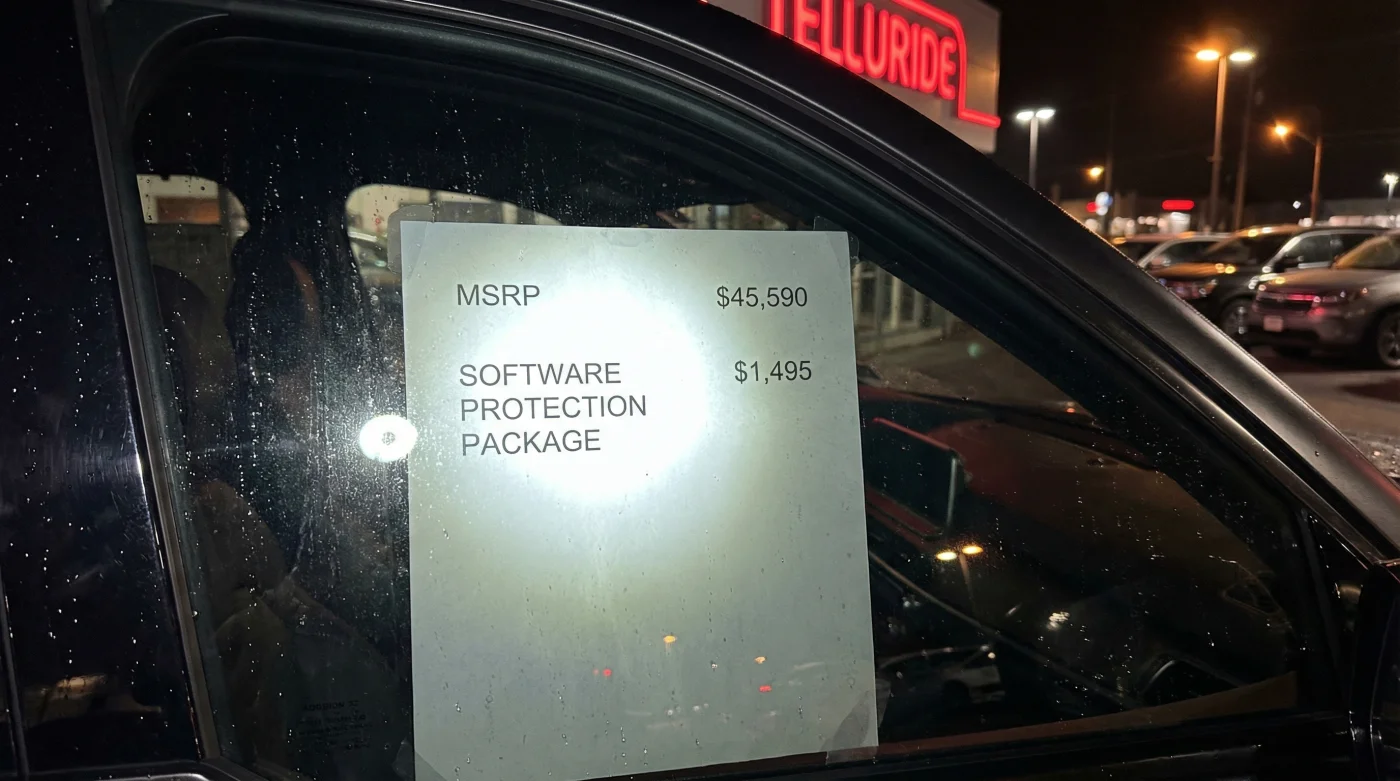
Picture the showroom floor just past closing time. The heavy glass doors are locked, the harsh fluorescent overheads are swapped for soft accent lighting, and the scent of new upholstery hangs thick in the air. Outside, the temperature has dropped to minus ten Celsius, but inside, the humming espresso machine makes the finance office feel deceptively warm. You sit across from the manager, a glossy brochure for the Kia Telluride Nightfall Edition resting between you.
You did your homework. You know the exact towing capacity, the fuel economy for those summer highway stretches lasting for miles, and the precise factory price down to the penny. The sticker price feels like a solemn promise, a baseline you successfully defended against rust-proofing and extended warranties. But the ink trembles as you notice a line item buried near the bottom of the final printed invoice.
It sounds official, bearing a title like Premium Connected Theft Protection or Dealership Asset Security. It reads like a luxury upgrade, something fitting for the blackout grille and brooding styling of your chosen SUV. In reality, you are looking at an invisible tax, a pre-loaded dealership software installation fee quietly attached to high-trim models to pad the margins when they know you are already mentally driving the car home.
The Illusion of the Factory Sticker
We are conditioned to treat the manufacturer suggested retail price as the unyielding bedrock of a vehicle purchase. You assume the physical metal, the painted trim, and the engineered transmission dictate the cost. It is like buying a bespoke suit and assuming the price tag covers the tailoring. Yet the real profit lies in what you cannot touch or see.
The perspective shifts when you stop looking at the car as a mechanical machine and start viewing it as a mobile smartphone. Dealerships have realized that slapping a premium markup on the hardware causes obvious friction. Instead, they pre-install third-party GPS tracking modules under the dashboard the moment the carrier truck unloads the vehicle. They frame this forced software integration as an exclusive security upgrade, hoping you accept it as an inherent part of the Nightfall aesthetic.
Marcus Thorne, a 46-year-old former dealership comptroller from the Greater Toronto Area, knows this playbook intimately. Over coffee one freezing February morning, Marcus traced the lineage of this specific charge. He explained how they used to sell paint protection, but now, an entry-level technician splices a fifty-dollar locator chip into the diagnostic port, and the finance office mandates an eight-hundred-dollar activation fee. We tell the customer it lowers their insurance premiums, knowing full well the factory software already tracks the car for free. It is an invisible ransom disguised as peace of mind.
Adjusting Your Strategy at the Finance Desk
Not all buyers experience this hidden fee the exact same way. The way this software charge is pitched morphs depending on how you structure your deal. Recognizing your specific category gives you the leverage to politely decline the ghost tax without ruining the rapport you built on the sales floor.
For the Cash Buyer, you are the hardest target. Because you carry no financing interest, the dealership tries to inject this software fee as a non-negotiable security requirement. They will insist it protects their inventory while it sits on the lot. Your counter is simple and polite: their lot insurance is not your financial burden once the title transfers.
For the Lease Negotiator, the fee is heavily camouflaged. They will bury the cost into the capitalized base, meaning you pay interest on a software suite you will ultimately hand back in three years. When the finance manager insists on the charge, the explanation often sounds like breathing through a pillow, muffled, practiced, and distinctly uncomfortable.
- Kia Telluride nightfall editions carry invisible dealership software installation fees
- Subaru Outback touchscreen redesign quietly removed the critical physical defroster buttons
- Chevy Silverado lifter failure makes the Ram 1500 surprisingly more reliable
- Used Jeep Wrangler tailgate hinges reveal critical frame rust immediately
- Honda Accord transmission shuddering is instantly fixed by disabling this dashboard setting
Dismantling the Invisible Fee
Fighting this charge requires a calm, deliberate approach rather than a heated argument. Treat the finance office like a delicate recipe; the cream should tremble, not boil over. You want to maintain the relationship while firmly setting your boundaries and protecting your wallet.
When the contract is presented, read it line by line. Start with total absolute silence when your finger lands on the software activation fee. Do not ask what it is. State clearly that you are declining the third-party module and request a new printout.
- Request the physical removal of the third-party GPS module. State clearly that you rely solely on the factory Kia Connect application for your security needs.
- If they claim it is a mandatory lot policy, kindly ask to see the secondary window addendum sticker. If it was not disclosed on the physical vehicle, it cannot be legally enforced at the desk.
- Remind them that third-party splices into the wiring harness can complicate future warranty claims with the manufacturer, which is a risk you are unwilling to take.
Your Tactical Toolkit for this negotiation includes a fully charged smartphone with your current insurance provider on speed dial, a printed copy of the factory security capabilities, and the willingness to stand up and walk away. A dealer will rarely lose a fifty-thousand-dollar sale over an eight-hundred-dollar ghost fee.
Driving Away With Clarity
The satisfaction of securing a high-demand vehicle like the Telluride Nightfall Edition goes beyond the raw horsepower. It goes beyond the steering wheel feeling beneath your palms on a crisp morning. It is rooted in the quiet confidence of knowing exactly what you paid for, without the lingering anxiety of invisible taxes.
You hold the final authority. Reclaiming your agency at the dealership ensures that when you finally pull out of the lot and hit the pavement, the only thing you are carrying is the exhilaration of the drive, not a hidden tether back to the finance office.
The most expensive option on any modern vehicle is the one the dealer installs when you aren’t looking.
| Key Point | Detail | Added Value for the Reader |
|---|---|---|
| Factory Tracking | Built-in Kia Connect system | No extra cost, covers standard security needs directly from the manufacturer |
| Dealer GPS Module | Cheap third-party locator dongle | Eliminates an eight-hundred-dollar markup by confidently refusing the activation |
| Wire Splicing | How modules attach to the diagnostic port | Protects your factory electrical warranty by keeping the wiring harness untouched |
Frequently Asked Questions
Is the dealer-installed GPS tracking mandatory?
No. Despite what the finance manager might suggest, third-party software add-ons are entirely optional and can be declined before signing.Does refusing this software void my Kia warranty?
Actually, the opposite is true. Allowing a third-party module to be spliced into your wiring harness poses a greater risk to your factory warranty.Why do they target the Nightfall Edition?
High-trim models attract buyers willing to spend more on premium features, making it significantly easier to hide luxury-sounding security fees.Can they refuse to sell me the car if I decline the fee?
While a private business can refuse a sale, they rarely will. The profit on the vehicle itself heavily outweighs the margin on the software fee.Will my insurance go up without this specific tracker?
Your insurance provider will recognize the factory-installed system for standard anti-theft discounts; you do not need the dealer’s redundant tracker.