Frost sits thick on the windshield, your breath curling into the minus 15 Celsius air as you pull the heavy winter door shut. You slide into the driver’s seat, pressing the ignition. The engine catches with a familiar hum, but as you shift the gear selector into drive, there is a hesitation. It is a faint, metallic whine rising through the floorboards—a sound that definitely was not there last November.
Most drivers brush this off as just another cold-weather quirk. You assume the mechanical fluids simply need a minute to warm up, trusting the dashboard’s silence over the mechanical reality groaning beneath the vehicle. But that subtle metallic whine is actually the sound of borrowed time, echoing from the most misunderstood component in your driveway.
The modern continuous variable transmission, or CVT, is a brilliant piece of engineering designed to keep your RPMs in a state of perfect, seamless balance. Without traditional gears, it relies on a steel belt gliding across adjustable pulleys to maximize fuel efficiency. It feels incredibly smooth, practically invisible, right up until the day it suddenly shudders on the highway off-ramp.
The manual sitting in your glovebox likely tells a reassuring story. It claims the fluid sealed inside that aluminum housing is good for the life of the vehicle, requiring zero maintenance. Yet, believing that factory promise is exactly what leaves thousands of drivers stranded on the side of the 401, facing a brutal repair bill just weeks after their powertrain coverage quietly expires.
The Myth of the Eternal Machine
Think of the heavy steel push-belt inside your CVT sliding constantly over two polished metal cones. Now, imagine lubricating that extreme friction with cooking oil. Over time, heat and pressure do not just warm the oil; they literally shear its chemical structure apart at the molecular level. Driving with degraded fluid is like an athlete breathing through a pillow—the mechanical effort is doubled, but the output is entirely suffocated.
The fluid inside your transmission is tasked with an impossible paradox. It must provide enough lubrication to prevent the metal surfaces from scoring each other, while simultaneously offering enough friction to grip the steel belt tightly under hard acceleration. When the fluid breaks down, that delicate balance is shattered.
The phrase “lifetime fluid” is a marketing term, not a chemical reality. To the manufacturer, the “life” of the vehicle simply means the duration of the warranty. Once the odometer clicks past that 100,000-kilometre mark, the financial burden of degraded fluid and slipping belts shifts entirely away from the automaker and directly onto your shoulders.
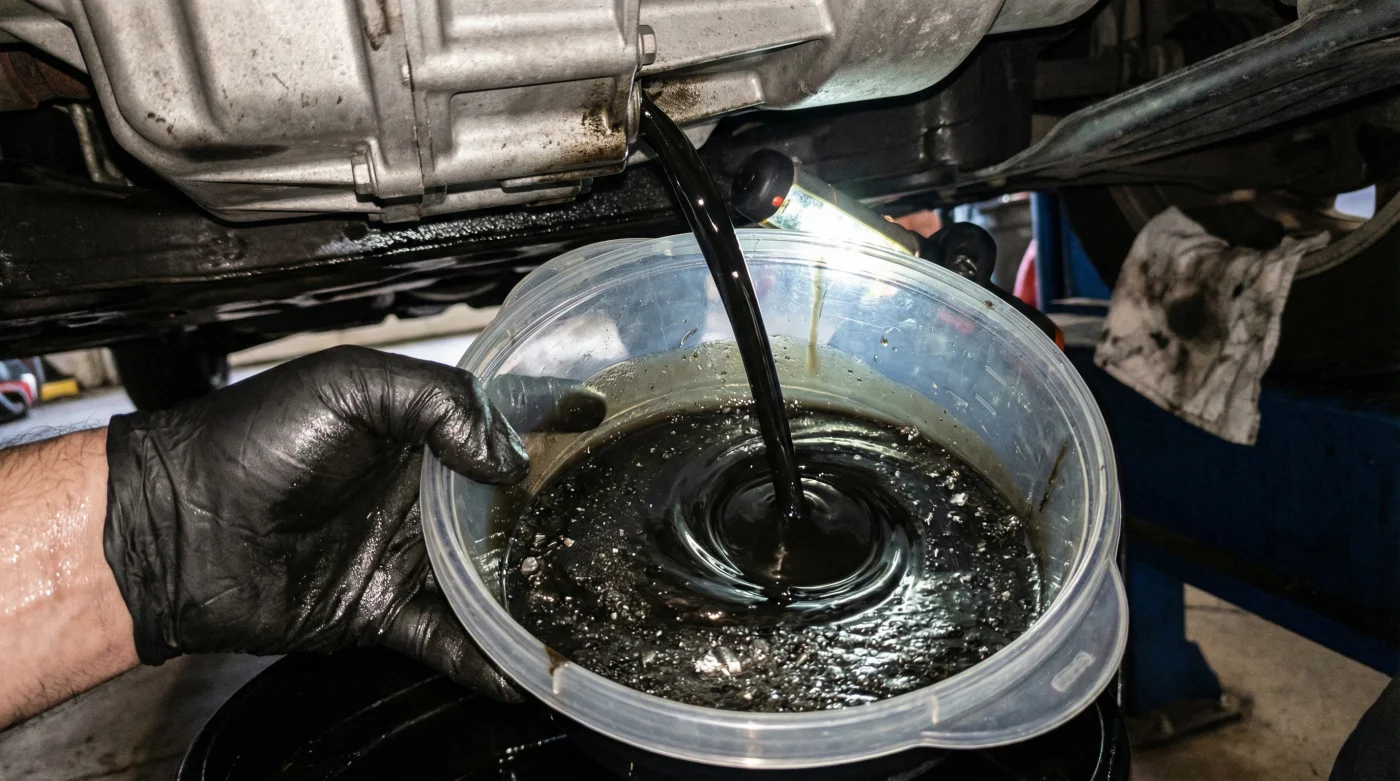
Ask David, a 54-year-old transmission specialist who runs a quiet, independent shop just outside Calgary, about this factory advice. He keeps a glass mason jar of fluid drained from a six-year-old crossover sitting on his front desk. It isn’t the translucent amber or cherry red of fresh factory lubricant; instead, it looks exactly like burnt black coffee syrup, thick with suspended metal shavings.
“The automakers aren’t lying to you,” David often tells his frustrated customers as they stare at the jar. “They just have a very different definition of a lifetime than you do. The steel push-belts in these gearboxes are practically bulletproof. It is the fluid holding the microscopic metal particles in suspension that behaves like liquid sandpaper after 60,000 kilometres.”
Tailoring the Maintenance Window
For the Stop-and-Go Commuter
If your daily route involves creeping along the Don Valley Parkway or idling through endless suburban red lights, your transmission runs incredibly hot. Constant shifts in momentum force the CVT pulleys to widen and narrow continuously, generating intense internal temperatures that cook the friction modifiers out of the fluid much faster than steady driving.
In this high-stress environment, the factory recommendation is completely divorced from your reality. You are operating under severe conditions. The constant engagement and disengagement mean fluid degradation happens at nearly double the expected rate, requiring a far more aggressive approach to preservation.
For the Highway Cruiser
- The 2024 Subaru Forester Trim You Should Actually Buy Instead of the Touring
- The Hidden Suspension Flaw Plaguing Used Chevrolet Tahoes
- The Seatbelt Test That Reveals Hidden Flood Damage Dealerships Wash Away
- Mechanics Reveal the CVT Maintenance Schedule That Automakers Hide
- Why the Fully Loaded Toyota RAV4 is a Worse Value Than the Base Lexus NX
Even in these ideal conditions, the chemical anti-foaming additives will eventually break down. You have much more breathing room than the city commuter, but you cannot ignore the calendar entirely. Time, oxygen, and microscopic metal wear still take their toll on the fluid’s viscosity.
Reclaiming Your Maintenance Schedule
Protecting your investment does not require a masterclass in automotive mechanics or thousands of dollars. It simply requires a shift away from passivity toward intentional, scheduled intervention before the symptoms of failure begin to appear.
The process of maintaining this system is surprisingly straightforward once you bypass the dealership’s default “do nothing” advice. Treat the fluid as a standard wear item, just like your brake pads or wiper blades.
- Demand a gravity drain and fill: Never let a service station perform a pressurized “fluid flush” on a CVT. You simply want a gentle gravity drain and refill to introduce fresh chemical additives without forcefully dislodging trapped metallic dust into delicate valve bodies.
- Use the exact factory formulation: This is not the place for generic, auto-parts-store mixtures. CVT belts require incredibly specific friction modifiers to prevent slipping. Always buy the manufacturer-branded bottle, even if it costs slightly more at the parts counter.
- Change the external paper filters: Many drivers completely miss the small paper or mesh filters housed just outside the transmission casing. Swapping these out takes ten minutes and preserves the critical pump pressure required to squeeze the pulleys together.
Your Tactical Toolkit:
– Severe driving replacement interval: 50,000 kilometres.
– Normal driving replacement interval: 80,000 kilometres.
– Diagnostic tool: A basic OBD2 scanner capable of reading live transmission fluid temperatures (ideal operating range is 70 to 90 Celsius).
The Peace of the Open Road
Taking control of this hidden maintenance schedule fundamentally changes the way you interact with your vehicle. You are no longer driving in a state of quiet anxiety, waiting for a sudden mechanical failure to dictate your family finances or leave you stranded in the cold.
Instead, you are actively preserving the delicate balance of engineering beneath the floorboards. The car stops being a mysterious appliance that might break without warning, and becomes a transparent machine that rewards your mindful attention with absolute reliability.
When the dead of winter returns next year and the temperature drops sharply, you will turn the key with complete confidence. The engine will catch, you will shift the selector into drive, and the acceleration will feel like glass—smooth, unbroken, and ready for whatever the Canadian pavement demands.
“True mechanical longevity isn’t built on the assembly line; it’s preserved in the driveway by simply ignoring the phrase ‘maintenance-free’.”
| Key Point | Detail | Added Value for the Reader |
|---|---|---|
| Factory ‘Lifetime’ | Usually translates strictly to the 100,000 km powertrain warranty period. | Saves you thousands by acting before the warranty expires. |
| Drain vs. Flush | Always perform a gentle gravity drain, never a pressurized machine flush. | Prevents catastrophic valve body clogs from dislodged debris. |
| Fluid Type | CVTs require hyper-specific friction modifiers; generic fluids cause belt slip. | Ensures smooth power delivery and eliminates low-speed shuddering. |
FAQ: Mastering CVT Longevity
Is a slight whine normal in cold weather?
While fluids are thicker in extreme cold, a pronounced metallic whine often indicates the fluid pump is struggling with degraded, thickened lubricant. Fresh fluid flows easily even at minus 20 Celsius.Will changing my fluid void the factory warranty?
No. Performing preventative maintenance using factory-approved fluids and documenting the service protects your vehicle. Automakers cannot void a warranty for changing fluids earlier than required.How do I know if my CVT is already slipping?
Watch the RPM gauge on your dashboard. If the needle surges upward rapidly while your actual road speed barely increases, the steel belt is failing to grip the pulleys.Can I check the fluid level myself?
Many modern units are sealed without a traditional dipstick. However, an inexpensive OBD2 scanner can read the fluid temperature, which is the exact method mechanics use to verify proper fluid levels during a refill.Why doesn’t the dealership suggest this service?
Service advisors are trained to follow the exact factory maintenance booklet. Recommending services outside that booklet creates friction, even if independent mechanics know those recommendations are heavily flawed.