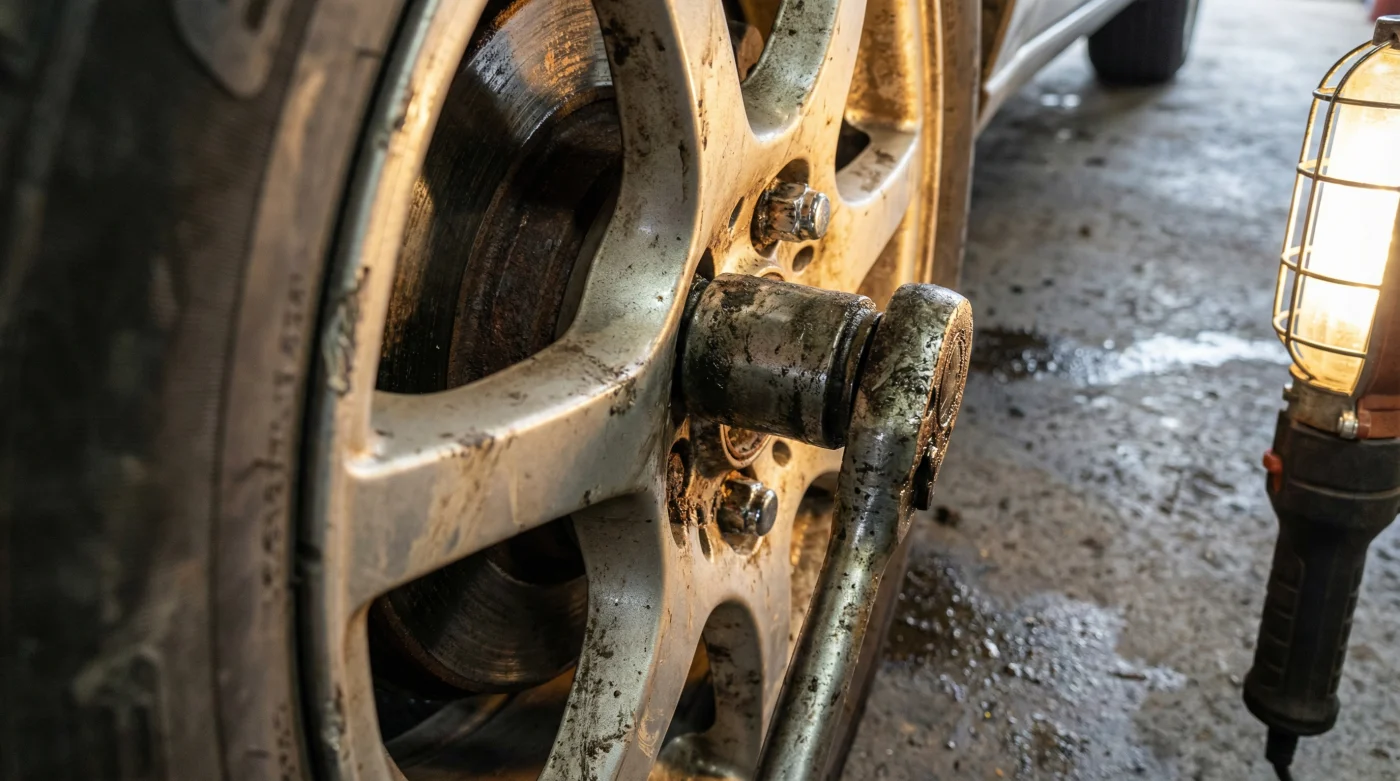
Picture yourself descending a steep grade in the Rockies, maybe somewhere just outside Banff. The air is crisp, sitting around 5 degrees Celsius. You gently press the brake pedal to check your speed, and suddenly, your steering wheel vibrates like a paint shaker. Your travel mug rattles in the cup holder. You feel that pulsing rhythm pushing back against your right foot. You probably curse your driving habits, assuming those long downhill stretches baked your brake discs into wavy metal.
Most of us grew up believing that hard braking creates immense friction, pushing temperatures well past 400 Celsius, which somehow melts and warps heavy cast-iron rotors. But metal does not behave like a plastic dashboard left in the summer sun. The truth is quieter, more insidious, and usually happens in a brightly lit service bay months before you ever hit the highway.
The Phantom Heat Myth
Think of your brake rotor as a rigid dinner plate sandwiched between the wheel hub and your alloy rim. When you bolt the wheel on, you are clamping that plate down. If the pressure is not perfectly even, the plate is forced into a microscopic bind.
It is an issue of geometry, not just thermal dynamics. When a heavy cast-iron disc is bolted unevenly to the vehicle, the constant rotation combined with the friction of the brake pads causes the metal to wear down in high spots. We call it ‘warped’, but mechanical specialists know it as disc thickness variation. The rotor is not waving; it has hills and valleys carved into it because it was bent from the moment the tire was installed.
| Driver Profile | The Pain Point | The Fix & Benefit |
|---|---|---|
| The Seasonal Commuter | Vibrations a few months after swapping winter tires. | Demand hand-torquing. Saves $400+ on premature brake jobs. |
| The Used Car Buyer | Test driving a car with a pulsing brake pedal. | Use it as leverage. Know the fix is mechanical, not a ruined suspension. |
| The Weekend DIYer | Over-tightening lug nuts with a rusty tire iron. | Invest in a calibrated torque wrench for perfectly seated wheels. |
Enter Dave, a suspension specialist working out of a dusty bay in Mississauga. He once pointed to a stack of ruined rotors in the corner of his shop and told me a secret most tire shops will not admit. “Those are not victims of heat,” he said, wiping grease onto a blue shop towel. “They are victims of a Friday afternoon rush.”
He explained how a technician with a pneumatic impact wrench—the heavy air-tool that sounds like a rapid-fire machine gun—often hammers lug nuts home in a circle rather than a crisscross pattern. When one nut is blasted to 150 foot-pounds and the one next to it is barely sitting at 80, the underlying cast-iron ‘hat’ of the rotor is pulled unevenly against the hub.
| Action / Force | Mechanical Reality | Result on the Rotor |
|---|---|---|
| Pneumatic Impact Gun (Uneven) | Applies 100-200+ ft-lbs randomly across the hub flange. | Bends the rotor hat, creating runout. Pads rub unevenly. |
| Tightening in a Circle | Pinches one side of the wheel, leaving the opposite side loose. | Forces the cast iron out of alignment with the brake caliper. |
| Torque Wrench (Crisscross) | Applies exactly 80-100 ft-lbs (spec dependent) evenly. | Rotor stays perfectly flat. Even pad wear, zero pedal pulsation. |
Defending Your Brakes
You do not need to be a licensed mechanic to protect your car from a trigger-happy tire technician. You just need to change how you approach your seasonal tire swaps. Whether you are putting on your winter rubber or trading up to summer alloys, insist on the hand-torque method.
- Federal EV rebates exclude popular Tesla models starting next month
- Transport Canada winter tire mandates are leaving major insurers denying claims
- Warped brake rotors are actually caused by improper lug nut torque
- Premium gas decreases fuel efficiency in standard Honda CR-V models
- Graphite powder fixes sticky Ford door latches better than liquid lubricants
If you do this in your own driveway, buy a dedicated torque wrench. Set it to your manufacturer’s specification—usually around 80 to 100 foot-pounds. Pull the wrench steadily until you hear that satisfying, singular click. Do not bounce on the handle, and do not give it an extra tug for good measure.
| What To Look For | What To Avoid |
|---|---|
| Technician uses a torque wrench to finish tightening. | Technician hammers the nut for 5 seconds with an air gun. |
| Lug nuts are tightened in a star or crisscross pattern. | Lug nuts are tightened in a continuous circle. |
| The shop offers a ‘re-torque’ after 100 kilometres. | The shop tells you ‘they are on there good and tight.’ |
| Hub faces are cleaned of rust before the rotor is placed. | Slapping new parts over thick, flaky rust. |
The Rhythm of the Road
Understanding this mechanical relationship changes how you view your vehicle. It is no longer just a heavy machine prone to mysterious, expensive failures. It is a series of precise connections. When those connections are respected, the car hums along the pavement with a reassuring smoothness.
No more steering wheel shudders on the highway. No more replacing expensive cast-iron discs every twenty thousand kilometres. You are bringing a sense of mindfulness into the garage, ensuring that every bolt is tightened with intention, not just blind force. It is a small detail, but it makes all the difference in the world.
“A brake rotor rarely bends from a hard stop; it distorts because the wheel holding it was bolted down with the finesse of a sledgehammer.”
Frequently Asked Questions
Can I fix a warped rotor once it starts vibrating?
If there is enough metal left on the disc, a machine shop can sometimes resurface it on a lathe to make it flat again, but replacing it is often safer and more cost-effective.Do I really need to re-torque my wheels after 100 kilometres?
Yes. The thermal expansion from driving can cause newly seated wheels to shift slightly, loosening the initial clamp load.Why does the steering wheel only shake when I brake at high speeds?
High speeds amplify the microscopic thickness variations in the rotor. At low speeds, the suspension absorbs the slight wobble, but at 110 km/h, it translates directly into the steering column.Is it okay to use anti-seize on lug nut threads?
Most manufacturers advise against it. Lubricating the threads alters the friction, meaning your torque wrench will drastically over-tighten the nut even if set to the correct number.What is the proper way to tighten a 5-lug wheel?
Always use a star pattern. Tighten one nut, skip the next one, tighten the third, and so on. This ensures the wheel sits perfectly flush against the rotor and hub.