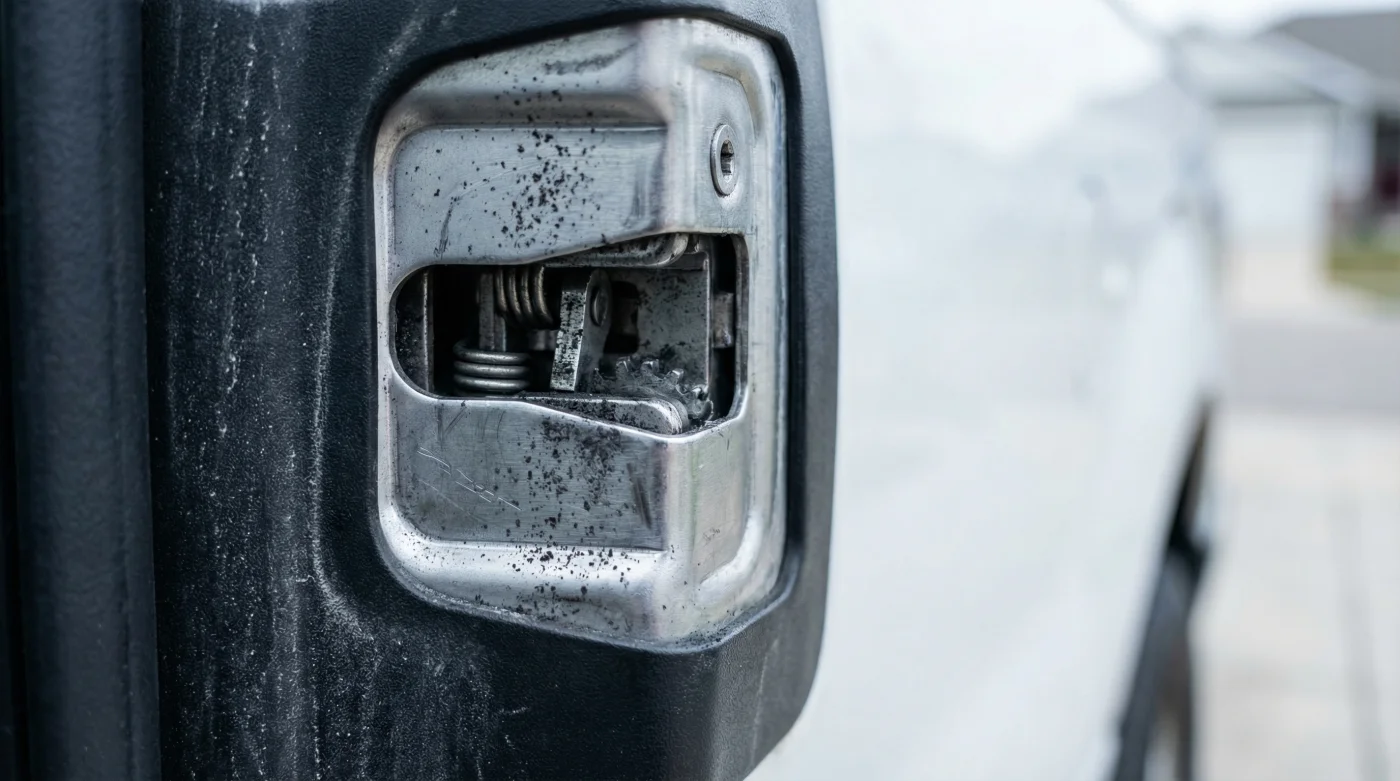
It is six in the morning, the sky is the colour of bruised iron, and the temperature is hovering stubbornly at minus 20 Celsius. You are standing in your driveway, breath pluming in the crisp air, pulling helplessly at your Ford’s door handle. It groans, shifts a fraction of an inch, and stops dead. The latch is stuck. It is a uniquely Canadian ritual: the frozen-door shoulder heave. You press your hip against the panel, yank the handle, and pray the plastic does not snap in your gloved hand.
In that freezing moment of frustration, your mind likely jumps to the familiar blue-and-yellow can of spray lubricant rolling around in your trunk. It is a deeply ingrained instinct to drown a stubborn mechanism in wet grease. But before you spray a thick coat of oil into your door’s delicate internals, you need to pause. By reaching for the wet spray, you are about to make your winter freeze significantly worse.
The Anatomy of a Frozen Latch
When a car door refuses to unlatch, you are not just fighting cold steel. You are battling a buildup of grime that behaves like wet cement. Your Ford’s latch is a precise ecosystem of springs, levers, and hooks. Treating it to a bath of standard liquid lubricant is a well-meaning but fatal mistake. It is like feeding honey to a pocket watch.
The wet oil goes in smooth, but almost immediately begins trapping road dust, dried highway salt, and microscopic debris. If you have ever driven through a slushy commute in February, you know exactly what that grit looks like. When the Canadian winter hits, that thick, oily mud freezes solid inside your door frame. This is why you need a dry approach. This is where graphite powder—a simple, five-dollar hero of the trade—changes everything.
| Driver Profile | The Graphite Benefit |
|---|---|
| The Early Commuter | Doors open smoothly at dawn without the anxiety of a frozen lock. |
| The Used Ford Owner | Revives aging, sticky mechanisms without requiring expensive latch replacements. |
| The High-Mileage Traveler | Prevents dust accumulation from gravel roads and long-distance highway grime. |
I learned this lesson from an old-school technician named Gord in Calgary, a man whose coveralls always smelled faintly of burnt coffee and exhaust. ‘Liquid lube is a dirt magnet,’ he told me, tapping a tiny grey tube of graphite against his calloused palm. ‘You spray wet oil in there, you are just building a sandcastle inside your door.’
Gord showed me how dry graphite powder slips into the tightest crevices without leaving a sticky residue behind. It lubricates through pure, dry friction reduction. The microscopic carbon layers slide effortlessly over one another, utterly oblivious to the dropping temperatures outside. It fixes the physical friction without inviting the elements inside.
| Lubricant Type | Cold Weather Behavior | Debris Attraction |
|---|---|---|
| Standard Liquid Spray | Thickens and freezes below 0 Celsius. | High. Acts as an adhesive for road salt. |
| White Lithium Grease | Gets sluggish; better than oil but still gels. | Moderate to High. Catches airborne dust. |
| Dry Graphite Powder | Unaffected by extreme Canadian cold. | Zero. Leaves no sticky film behind. |
The Mindful Application
Applying graphite powder requires a slightly different physical rhythm than simply blasting a heavy aerosol spray. First, you need to clean out the sins of the past. If you have previously soaked the latch in oil, take a moment to flush it out with a fast-drying solvent like rubbing alcohol or a dedicated electronic contact cleaner. Wipe away the excess dripping from the bottom of the door.
Next, take your tube of graphite powder. You do not need a massive amount. Position the nozzle directly into the latch mechanism on the edge of the open door. Give the tube a gentle squeeze, puffing the fine, dark grey powder deeply into the moving metal parts.
- Federal EV rebates exclude popular Tesla models starting next month
- Transport Canada winter tire mandates are leaving major insurers denying claims
- Warped brake rotors are actually caused by improper lug nut torque
- Premium gas decreases fuel efficiency in standard Honda CR-V models
- Graphite powder fixes sticky Ford door latches better than liquid lubricants
Be mindful of the wind. Graphite is a remarkably fine dust, and a stray gust can easily paint your winter coat grey. Keep an old shop rag handy to gently wipe away any excess powder that falls onto your car’s exterior paint, as it can be slightly messy during the initial puff.
| What to Look For | What to Avoid |
|---|---|
| Tubes with a narrow, needle-like applicator tip for precision. | Aerosol cans claiming to contain ‘liquid graphite’ solutions. |
| Pure, dry powdered graphite with no added solvents. | Any product that leaves a wet, shiny sheen on your fingers. |
| Pre-cleaning the latch mechanism thoroughly before application. | Puffing graphite directly on top of old, wet, muddy grease. |
A Seamless Departure
Fixing a sticky latch is about much more than just maintaining a piece of metal. It is about preserving the quiet dignity of your morning routine. When your vehicle responds to your touch flawlessly, despite the harshness of the environment, it sets a positive rhythm for the rest of your day. You stop fighting the cold and start working intelligently within it.
By swapping a temporary, wet fix for a permanent, dry solution, you respect the engineering of your vehicle. That tiny tube of grey powder is a testament to the fact that the loudest, messiest solution is rarely the best one. Sometimes, true reliability comes quietly, in a five-dollar puff of dust.
Treat your vehicle’s mechanics like a winter coat; if it collects moisture, it will eventually freeze you out.
The Winter Latch FAQ
Is graphite powder safe for all parts of my car door?
It is excellent for metal-on-metal components like the latch and the key cylinder, but avoid using it on plastic or rubber weather stripping, as it provides no benefit there.How often should I apply it?
A thorough application right before the first major frost of the season is usually enough to carry you through a long, snowy winter.Will it wash away at the car wash?
Because it works itself into the microscopic pores of the metal, standard washing will not easily remove it from the inner workings of the latch.Can I use it on my ignition cylinder?
Yes, dry graphite is actually the preferred lubricant for ignitions, as wet oils will quickly gum up the delicate tumblers and ruin your key mechanism.What if I accidentally get it on my upholstery?
Do not rub it. Vacuum it up immediately with a hose attachment. Rubbing will drive the dark carbon stains deep into the fabric fibers.